Factory-direct steel gratings & stair treads, shipped worldwide
Heel-Proof Grating
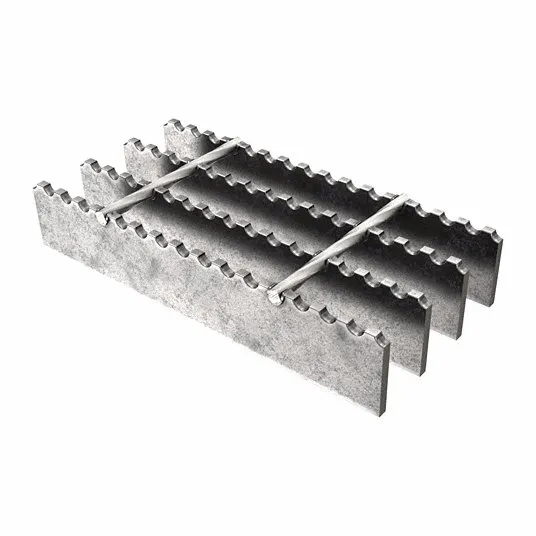
Heel-proof teeth grip wet or oily soles. Fewer slips on site.
Itemized quote within 24 hours · Free drawing review included
In-house press-lock line
Close mesh down to 11 / 11 mm under one roof
Certified & tested
Reports on request, MTC with every order
Samples in 5–7 days
Production in 15–25 working days
FOB Tianjin
Shipped worldwide, EXW / CIF negotiable
Heel-proof geometry
Heel vs Opening: Why the Mesh Decides
Heel proof grating is a geometry decision before it is a product: keep every opening smaller than what walks over it. Here is how the geometry works — and how close mesh compares with the alternatives on our floor.
A typical shoe heel, a cane tip or a caster wheel finds no gap to drop into when the mesh is fine enough. The walking surface stays continuous underfoot, and the sole always lands on steel edges instead of straddling a hole.
The practical route on our floor is press-locked close mesh — flat bearing bars and cross bars interlocked under pressure with centers down to 11 / 11 mm. No welding heat enters the joint, so fine-pitch panels stay dead flat for public floors.
- Openings too small for a heel — 11 / 11 mm centers put many bar edges under one footprint
- Public-space duty — station platforms, malls, schools, sidewalks and tree pits, in ordinary shoes
- ADA-adjacent by geometry — accessibility reads as opening size and flushness; see our ADA grating guide
Schematic, not to scale: same shoe over two meshes. Close mesh keeps the heel on the surface; standard mesh lets it drop.
| Dimension | Close-Mesh Press-Locked | Standard Welded Mesh | Serrated Surface |
|---|---|---|---|
| Opening geometry | Down to 11 / 11 mm centers — openings smaller than a heel | 30 / 40 / 60 mm centers — sized for drainage and load, not dress shoes | Openings follow the base panel; the toothed bar tops add bite |
| Heel behavior | Heel, cane tip and caster bridge the bars and stay on the surface | A narrow heel can drop into the mesh and catch | Heel bridges as on its base panel, with teeth gripping the sole |
| Underfoot feel | Many bar edges per footprint — steady under dress shoes | Open, industrial feel underfoot | Aggressive texture; a matter of preference for public floors |
| Debris & drainage | Many small channels; fine debris stays on top for sweeping | Fast drainage; large debris falls through | Same as its base panel |
| Typical use | Stations, malls, schools, sidewalks, tree pits, trench covers | Plant platforms, industrial walkways, drainage | Wet floors, outdoor stairs, ramps |
| Our lines | In-house — press-lock machine | In-house — electro-forging line | Serration option on welded bars and press-locked flat bars |
Not sure which mesh fits your floor? Send your drawings — we will spec it inside the 24-hour quote.
How panels are made
From Notched Bars to a Heel-Proof Panel
1 · Notched flat bars
Flat bearing bars are cut and notched so cross bars register at close centers — the geometry that sets the opening size, decided at the bar, not later.
2 · Press-locked to 11 / 11 mm
Cross bars are pressed into the notches under load on our press-lock machine. No welding heat enters the joint, so fine-mesh panels stay dead flat for public floors.
3 · Hot-dip galvanizing
Panels go to a certified galvanizing partner near our mill for ASTM A123 / ISO 1461 hot-dip galvanizing — typically 2–3 days, already counted inside your production window.
Why specify heel-proof
Why Specifiers Choose Heel-Proof Close Mesh
Openings a heel cannot enter
Down to 11 / 11 mm centers, the mesh leaves no gap wide enough for a heel, cane tip or caster wheel — a walking surface that stays continuous in dress shoes.
Custom panels, any size
Heel-proof grating cut and banded to your drawings — panels up to 1.25 m wide and 6 m long, free drawing review in the 24-hour quote, small trial orders welcome.
Mill certificate with every order
Each batch ships with its MTC EN 10204 3.1 and factory inspection report — material paperwork that holds up in public-space project files.
Applications
Public-Space Duty: Where Heel-Proof Mesh Earns Its Keep
Wherever the public crosses steel in ordinary shoes — heels, trainers, school shoes — close-mesh panels keep the surface walkable. Heavier flat bars hold the same fine pitch where trolleys or maintenance traffic cross the floor.
Stations & transit platforms
Drainage floors and platform edges walked by thousands of ordinary shoes a day.
Malls & public concourses
Tree pits, trench covers and service floors where shoppers cross in dress shoes.
Schools & campuses
Courtyard drains and entrance mats that stay walkable for small feet and wheels.
Stairs & entrance treads
Heel-proof stair treads with close spacing and nosing options for public cores.
Specifications
Heel-Proof Grating Specifications
| Parameter | Range |
|---|---|
| Construction | Press-locked — flat bearing bars and cross bars interlocked under pressure |
| Close mesh | Down to 11 / 11 mm centers (heel-proof openings) |
| Bar section | 20×3 mm to 100×8 mm flat bars, plain or serrated |
| Panel width | Up to 1.25 m |
| Panel length | Up to 6 m |
| Materials | Q235B carbon steel · SS304 / SS316 stainless |
| Surface | Black or hot-dip galvanized (ASTM A123 / ISO 1461) |
| Industrial alternative | Welded mesh at 30 / 40 / 60 mm centers |
Materials & test documents
Every heat of Q235B, SS304 or SS316 enters production with its mill test certificate verified at goods-in — the first of our five QC stages. Panels leave with documentation, not promises:
- Mill test certificate to EN 10204 Type 3.1
- Factory inspection report with every shipment
- Declaration of Conformity prepared per order destination
Standards & compliance
Produced to Recognized Standards — Documents on Request
ANSI / NAAMM MBG 531
Close-mesh panels produced to MBG 531 reference practice, with mesh geometry checked on our five-stage QC plan.
ASTM A123 / ISO 1461 HDG
Galvanized coating thickness checked by sampling on every galvanized batch before panels are released.
CE & SGS tested
Certified & tested, reports on request — we show documents you can verify, not a certificate wall.
Writing an accessible-route spec? Opening size, flushness and edge treatment settle most of it. Our ADA grating guide walks the geometry qualitatively, and panels are produced to the standard you reference — ask in your quote.
Custom made
Custom Heel-Proof Panels, Cut and Banded to Your Drawings
Send your drawing
Floor areas, panel sizes, mesh pitch, quantities — or just photos and a sketch. Drawing review is free.
Quote within 24 hours
Itemized, FOB Tianjin as standard — EXW or CIF on request. Small trial orders welcome, no middlemen between you and the mill.
Samples in 5–7 days, production in 15–25
Working days after drawing confirmation, hot-dip galvanizing included. Installation drawings and fixing layout ship with the order.
Factory-direct quote
Get a Factory Quote
Send floor areas and mesh requirements — an itemized quote lands within 24 hours, free drawing review included.
- Five-stage QC, from MTC verification at goods-in to final inspection
- DoC, MTC EN 10204 3.1 and inspection report with every order
- Factory audits welcome — see the lines before you commit
Ask for your heel-proof quote today — samples are ready in 5–7 days.
Prefer to talk? WhatsApp us or sales@dtsteelladder.com
Request your quote
Five fields — we do the rest.
FAQ
Frequently Asked Questions
What makes a grating heel-proof?
Heel-proof is a geometry decision, not a coating: the openings are small enough that a typical shoe heel, cane tip or caster wheel cannot drop through. Our press-locked close mesh runs down to 11 / 11 mm centers, putting many bar edges under every footprint.
Is heel-proof grating the same as ADA grating?
They overlap but are not identical. Opening size is the geometry both share; accessibility guidelines typically add requirements such as a surface flush with the surrounding walk and secure fixing. We produce to the standard you reference and confirm it in your quote.
How fast can I get heel-proof grating?
A quote lands within 24 hours with free drawing review. Samples ship in 5–7 working days and mass production runs 15–25 working days after drawing confirmation, hot-dip galvanizing included.
Related pages
Related Safety Grating Pages
Pedestrian Grating
Pedestrian duty — heel-proof spacing plus walking comfort.
View page →Anti-Slip Grating
Serration, close mesh or grit — three routes to grip, compared.
View page →Serrated Grating
How serrated teeth grip wet or oily soles — mechanics only.
View page →Close-Mesh Grating
The fine-pitch process behind every heel-proof panel.
View page →Sidewalk Grating
Walkway-band page for public sidewalk and tree-pit duty.
View page →ADA Bar Grating
Standards-band page on accessible-route geometry, produced to.
View page →