Factory-direct steel gratings & stair treads, shipped worldwide
Bearing Bar Grating
Full bearing bar grating specs and size charts from the factory.
Itemized quote within 24 hours · Free drawing review included
One range, in-house
Bearing bars 20×3 to 100×8 mm on our own lines
Certified & tested
Reports on request, lot-tested quality, MTC with every order
Samples in 5–7 days
Production in 15–25 working days
FOB Tianjin
Shipped worldwide, EXW / CIF negotiable
Bearing bar anatomy
The Bearing Bar: The Member That Carries the Span
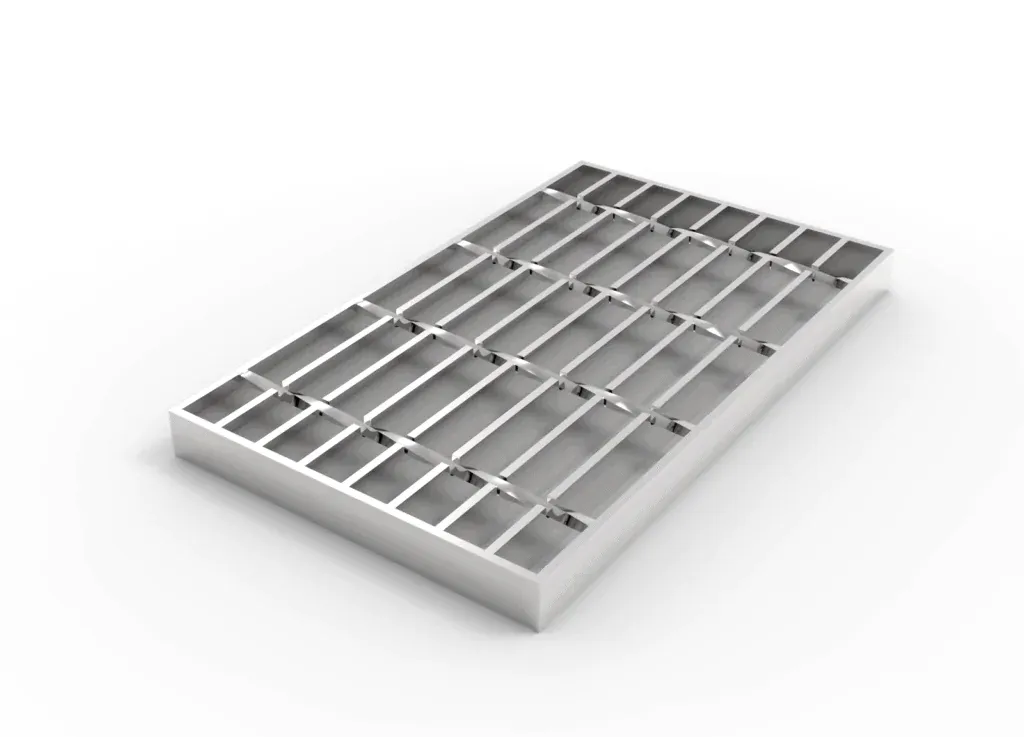
Every bar grating panel is two families of members. Bearing bars stand on edge and run across the clear span between your supports; cross bars only lock them in position. Load capacity, allowable span and steel grating weight all live in the bearing bars — so this is the member to specify first.
Plan view. The load arrow runs parallel to the bearing bars — traffic follows the span, and the span is carried by the bars.
Marking bar direction on your drawing
A grating panel is directional. Installed with the bearing bars across the span, it carries the design load; rotated so the bars run parallel to the supports, the same panel delivers almost nothing. Three marks on a shop drawing settle it:
An arrow for load direction
Draw the traffic or load arrow parallel to the bearing bars. That single mark tells the shop, and the installer, which way the panel must sit.
The clear span between supports
Span is measured along the bearing bar, support to support. Depth, thickness and spacing of the bars are then chosen against that span — not against panel size.
Bar spacing, center to center
30 / 40 / 60 mm centers across the panel width. Closer spacing shares concentrated loads across more bars and narrows the openings underfoot.
Send us the drawing — we confirm the section inside the 24-hour quote.
| Bar depth | Section in our range | Typical duty | See also |
|---|---|---|---|
| 20 mm | 20×3 mm — plain or serrated | Trench covers, pit grids and light access, with close support spacing | — |
| 25 mm (~1 in) | ~25 mm class sections, thickness 3–8 mm | Pedestrian walkways, access platforms, shallow covers | 1 in depth |
| 30 mm (~1 1/4 in) | ~30 mm class sections, thickness 3–8 mm | The everyday industrial walkway and platform depth | 1 1/4 in depth |
| 40 mm (~1 1/2 in) | ~40 mm class sections, thickness 3–8 mm | Longer clear spans between supports, heavier foot traffic | — |
| 50–100 mm (2 in and up) | Up to 100×8 mm — top of range | Heavy-duty decks, forklift routes, wheel and point loads | Heavy-duty bars |
Depth classes above are geometry descriptions, not load ratings. Plain or serrated tops are available across the whole range, and thickness runs 3–8 mm. The exact depth × thickness running section, load table and unit weight are confirmed with your quote.
Spans you are not sure about? Send your drawings — we will spec it inside the 24-hour quote.
How the numbers work
How Depth, Thickness and Spacing Drive Capacity and Weight
1 · Depth counts squared
The bending strength of a flat bar rises with the square of its depth. Doubling depth at the same thickness does far more for the span than doubling thickness ever will — which is why depth is the first number to fix, and why deep sections buy you wider support spacing.
2 · Thickness counts once
Strength grows in direct proportion to thickness, so thickness is the fine-tune, not the lever. Extra thickness earns its keep under concentrated loads and as corrosion allowance — and it is what stiffens a serrated top so the teeth hold their edge under traffic.
3 · Spacing sets the weight
Bar grating weight per square metre is mostly bearing bar steel: the bar cross-section times the number of bars per metre, which follows the spacing — 30 mm centers puts twice as many bars in a metre as 60 mm. Cross bars, banding and galvanizing add a small share. Unit weight is confirmed with your quote.
Why specify from the mill
Why Buyers Order Bearing Bar Grating Factory-Direct
Full specs and size charts, one range
Bearing bars from 20×3 mm to 100×8 mm, plain or serrated, at 30 / 40 / 60 mm centers — every depth class in one production range, so your walkway, trench and heavy-duty panels do not end up split across suppliers. Load tables and size charts come with the quote.
Samples in 5–7 working days
Check the section, the serration and the galvanized finish on a sample panel before the production run. Mass production runs 15–25 working days after drawing confirmation, hot-dip galvanizing included.
Factory-direct, FOB Tianjin
Buy bearing bar grating from the mill that cuts it: itemized quote within 24 hours, FOB Tianjin as standard, EXW or CIF negotiable. Certified & tested, reports on request — lot-tested quality with an MTC EN 10204 3.1 on every order.
Applications
Where Bearing Bar Selection Decides the Panel
Same panel geometry, different duties — each of these positions starts from the bearing bar: its depth against the span, its spacing against the traffic.
Platforms & walkways
Bars span between support beams; open mesh sheds water and debris under regular foot traffic.
Trench & pit covers
Short spans, but bar direction must match traffic — bars across the wheels, not alongside them.
Stair treads
Bearing bars run along the going; serrated tops and a nosing bar where the drawing calls for them.
Heavy-duty decks
The 100×8 mm end of the range for wheel and point loads, with closer centers to share them.
Specifications
Bearing Bar Grating Specifications
| Parameter | Range |
|---|---|
| Bearing bar | 20×3 mm to 100×8 mm — depth 20–100 mm, thickness 3–8 mm |
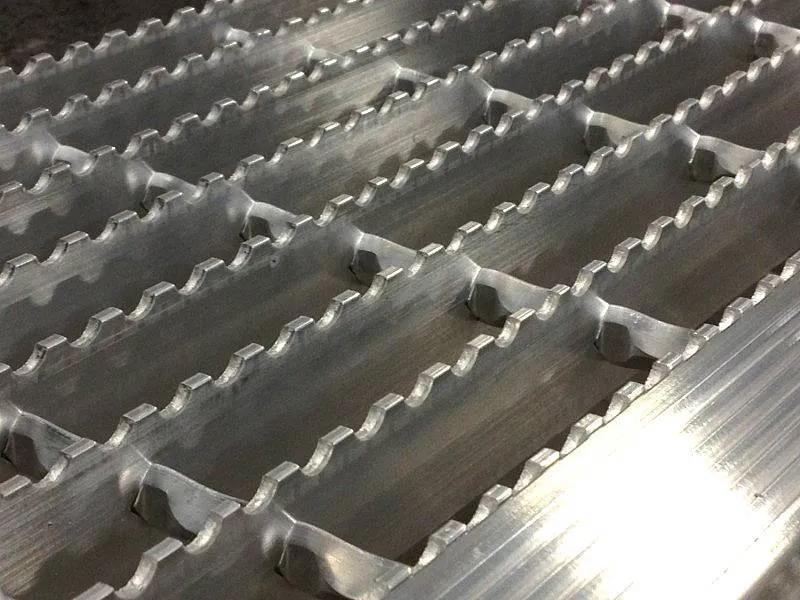
| Bar top | Plain or serrated, across the whole range |
| Bar spacing | 30 / 40 / 60 mm centers |
| Cross bar | Twisted square or round, per specification |
| Panel width | Up to 1.25 m |
| Panel length | Up to 6 m |
| Materials | Q235B carbon steel · SS304 / SS316 stainless |
| Surface | Black or hot-dip galvanized (ASTM A123 / ISO 1461) |
| Load & weight tables | Provided with your quote, calculated to your clear span |
Materials & test documents
Every heat of Q235B, SS304 or SS316 enters production with its mill test certificate verified at goods-in — the first of our five QC stages, and the reason a bar lot can be traced back to the steel it came from. Panels leave with documentation, not promises:
- Mill test certificate to EN 10204 Type 3.1
- Factory inspection report with every shipment
- Declaration of Conformity prepared per order destination
Standards & compliance
Produced to Recognized Standards — Documents on Request
ANSI / NAAMM MBG 531
Panels produced to MBG 531 reference practice, with weld inspection on our five-stage QC plan.
ASTM A123 / ISO 1461 HDG
Galvanized coating thickness checked by sampling on every galvanized batch before panels are released.
CE & SGS tested
Certified & tested, reports on request — we show documents you can verify, not a certificate wall.
Custom made
Custom Bearing Bar Sections, Cut and Banded to Your Drawings
Send your drawing
Panel sizes, clear spans, loads and bar direction if you know it — or just photos and a sketch. Drawing review and bar sizing help are free.
Quote within 24 hours
Itemized, FOB Tianjin as standard — EXW or CIF on request. The running depth × thickness section for your spans is confirmed here, with the load table attached. Small trial orders welcome.
Samples in 5–7 days, production in 15–25
Working days after drawing confirmation, hot-dip galvanizing included. Installation drawings and fixing layout ship with the order.
Factory-direct quote
Get Your Bearing Bar Grating Quote
Factory direct, 24h reply: send spans and quantities, and an itemized quote lands within 24 hours — free drawing review and bar sizing included.
- Five-stage QC, from MTC verification at goods-in to final inspection
- DoC, MTC EN 10204 3.1 and inspection report with every order
- Factory audits welcome — see the lines before you commit
Prefer to talk? WhatsApp us or sales@dtsteelladder.com
Request your quote
Five fields — we do the rest.
FAQ
Frequently Asked Questions
What is a bearing bar in steel grating?
It is the primary load-carrying member: a flat steel bar standing on edge, running across the clear span between two supports. Cross bars only lock the bearing bars in position — depth, thickness and spacing of the bearing bars decide what the panel carries. We run depths from 20 mm to 100 mm and thicknesses from 3 mm to 8 mm, with plain or serrated tops.
How do I choose bearing bar depth and thickness?
Set depth first: the bending strength of a flat bar rises with the square of its depth, so a deeper bar is far more effective than a thicker one. Add thickness for concentrated loads and corrosion allowance. Because the right section depends on your clear span, bar spacing and load type, we size it for you — send the span and loading, and the load and span tables come with your quote within 24 hours.
How is steel grating weight calculated?
Bar grating weight per square metre is mostly bearing bar steel: the bar cross-section (depth times thickness) multiplied by the number of bars per metre, which follows the spacing. Cross bars, banding and galvanizing add a small share. Deeper, thicker or more closely spaced bars mean more steel per square metre — unit weight for your exact section is confirmed with your quote.
Related pages
Related Specification Pages
Grating Load Bar
Specifying the load bar itself: depth, thickness and spacing.
View page →Twisted Bar Grating
Twisted cross bars between the bearing bars — how the mesh locks.
View page →I-Bar Grating
I-shaped bearing bars — weight savings at a comparable depth.
View page →1 1/4 Bar Grating
The 1 1/4 inch depth class in detail, with metric conversion.
View page →Bar Grating
The full category — every depth, spacing and finish.
View page →Plain Steel Grating
Plain-top panels — black steel and the uncoated option.
View page →