Factory-direct steel gratings & stair treads, shipped worldwide
Bar Grating Stair Treads
Stair treads with nosing and end plates, ready to install.
Itemized quote within 24 hours · Free drawing review included
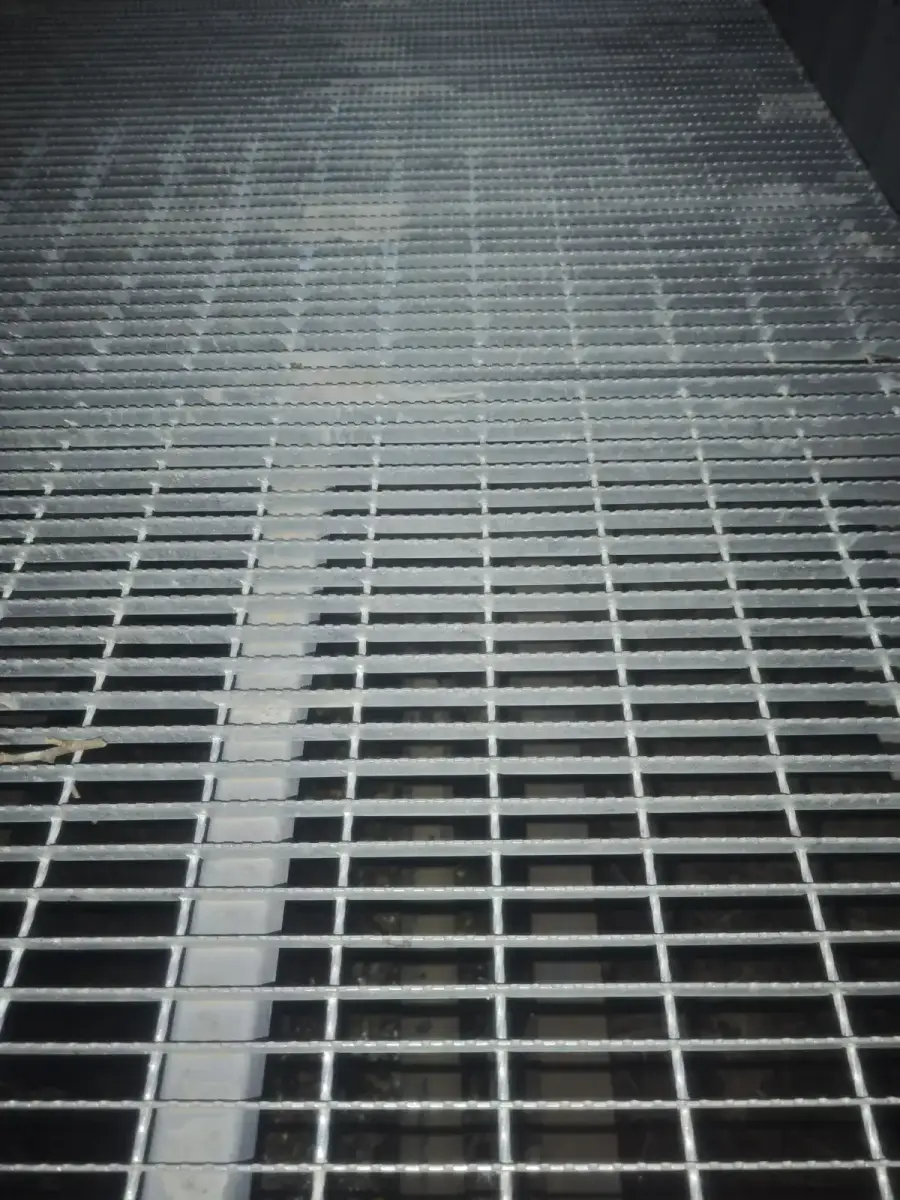
In-house weld & press lines
Treads cut from parent panels under one roof
Certified & tested
Reports on request, MTC with every order
Samples in 5–7 days
Production in 15–25 working days
FOB Tianjin
Shipped worldwide, EXW / CIF negotiable
Tread construction
Anatomy of a Bar Grating Stair Tread
Every bar grating tread we ship starts as a welded or press-locked parent panel, then becomes a stair unit: bearing bars carry the load, end plates carry the bolts, and the nosing carries the foot. Know the parts and you can specify the tread in one line.
Schematic — plan view of a grating tread. The bearing bars run between the two stringers, so the tread length is the span.
-
1
Bearing bars are the span
The load-carrying bars run the full tread length, from stringer to stringer. Bar size and spacing set how the tread behaves under foot and impact loads — the same range as our platform panels.
-
2
End plates with holes
Each end carries a drilled plate that bolts to the stringer — or arrives plain for site welding. Hole positions are cut to your drawing, so the tread lands on the stair as drawn, not as drilled.
-
3
Banded edges
The open mesh is closed with a band around the perimeter. Banded edges stop snag points, stiffen the tread and give the galvanizing an even line to run off.
-
4
Nosing options
The leading edge takes the wear. Choose a checker-plate nosing for heel traffic and edge visibility, or an angle nosing for heavier duty — over either a serrated or plain grating top.
Nosing types in detail on Grating Nosing · parent panels on Welded Steel Grating and Press-Locked Grating.
Top and Edge Options Compared
Anti-slip behavior comes from geometry, not coating. Here is how the three tread-top choices differ — described as mechanics, with no slip-test claims.
| Dimension | Serrated Top | Plain Top | Checker-Plate Nosing |
|---|---|---|---|
| Surface geometry | Serrated teeth on the bearing bars | Flat bearing bars, mill edge | Raised-pattern plate at the leading edge |
| Grip mechanism | Tooth geometry bites into boot soles | Parallel bar edges underfoot, open mesh sheds water | Pattern highlights the edge and adds a solid wear strip |
| Best suited to | Wet, oily, frost-prone and escape stairs | Dry indoor plant stairs | Heel traffic and low-visibility stair heads |
| Combines with | Checker-plate or angle nosing | Checker-plate or angle nosing | Serrated or plain grating tops |
| Cost framing | Serration is a rolling step on the bar, not added material | The economical tread top | Adds plate material and welding at the front edge |
| When quoting | State serrated bars | State plain bars | State nosing type and overhang |
Not sure which top suits your stairs? Send your drawings — we will spec it inside the 24-hour quote.
How treads are made
From Parent Panel to Ready-to-Bolt Tread
1 · Parent panel formed
Treads are cut from parent panels off our own welded or press-locked lines — the same bearing bars, spacing and mesh as our platform grating.
2 · Cut, drilled, banded
Panels are sawn and plasma-cut to tread size, end plates are drilled to your bolt positions, and edges are banded on our bending and cutting equipment.
3 · Galvanized and inspected
Treads go to our certified galvanizing partner for ASTM A123 / ISO 1461 hot-dip galvanizing — typically 2–3 days, already inside your production window — then pass final inspection with the shipment report.
Why specify treads this way
Why Contractors Order Grating Stair Treads From the Mill
Safer stairs, built into the geometry
Serrated tops and checker-plate nosing are design choices, not coatings — tooth geometry under the boot, a visible leading edge, and open mesh that never holds water on the going.
Nosing and end plates, ready to install
Treads arrive drilled, banded and nosed — bolt them to the stringers with the fixing layout we ship with the order. No site cutting, no site drilling, no hot work permits.
Factory-direct, samples in 5–7 days
Order straight from the mill that cuts, drills and galvanizes the treads — with a tread sample on your desk in 5–7 days and an itemized quote in 24 hours.
Applications
Where Steel Grating Stair Treads Work
Open-mesh treads that shed water, ice and debris — specified wherever a stair has to stay usable in conditions a solid tread would not.
Industrial & escape stairs
Serrated treads for plant stairs and emergency egress that must work when wet, iced or oily.
Platform & tank access
Access stairs to platforms, tanks and roof plants — treads ordered with the platform panels in one shipment.
Outdoor & washdown stairs
Hot-dip galvanized treads that drain instead of holding water — for exteriors and hose-down areas.
Replacement treads
One tread or one flight — measure the old tread, send the numbers, get a like-for-like replacement cut to fit.
Specifications
Bar Grating Stair Tread Specifications
| Parameter | Range |
|---|---|
| Parent panel | Welded (electro-forged) or press-locked |
| Bearing bar | 20×3 mm to 100×8 mm, plain or serrated |
| Bar spacing | 30 / 40 / 60 mm centers · press-locked close mesh to 11 / 11 mm |
| Tread width & length | Custom sizes to drawings |
| End plates | Drilled to your bolt pattern, or plain for site welding |
| Nosing | Checker plate or angle, over serrated or plain tops |
| Materials | Q235B carbon steel · SS304 / SS316 stainless |
| Surface | Black or hot-dip galvanized (ASTM A123 / ISO 1461) |
How to order: width × length × angle
Treads are ordered with three numbers — width (the going), length (the span between stringers, carried by the bearing bars) and the pitch angle of the flight. Add nosing type and end-plate holes, and the tread is fully defined. Full sizing guidance lives on Grating Stair Treads Dimensions.
- Mill test certificate to EN 10204 Type 3.1
- Factory inspection report with every shipment
- Installation drawings and fixing layout included
Standards & compliance
Treads Produced to Your Spec — References on Request
OSHA 1910.24, referenced
US specifiers reference OSHA 29 CFR 1910.24(c) for fixed industrial stairs. We produce treads to the loads and geometry you specify — we do not certify your installation.
ASTM A123 / ISO 1461 HDG
Galvanized coating thickness checked by sampling on every galvanized batch before treads are released — part of our five-stage QC plan.
CE & SGS tested
Certified & tested, reports on request — documents you can verify, not a certificate wall. Market-specific documentation discussed per order.
Custom made
Custom Treads, Cut and Drilled to Your Drawings
Send your drawing
Going, span, pitch angle, hole positions, quantities — or just photos and a sketch of the existing flight. Drawing review is free.
Quote within 24 hours
Itemized, FOB Tianjin as standard — EXW or CIF on request. Small trial orders welcome, including single replacement flights.
Samples in 5–7 days, production in 15–25
Working days after drawing confirmation, hot-dip galvanizing included. Installation drawings and fixing layout ship with the order.
Factory-direct quote
Get a Factory Quote
Get a factory quote in 24 hours — treads, nosing and covers in one order. Send the going, span and pitch, and an itemized quote lands the next working day.
- Five-stage QC, from MTC verification at goods-in to final inspection
- DoC, MTC EN 10204 3.1 and inspection report with every order
- Factory audits welcome — see the lines before you commit
Prefer to talk? WhatsApp us or sales@dtsteelladder.com
Request your quote
Five fields — we do the rest.
FAQ
Frequently Asked Questions
How do I order bar grating stair treads?
Give us three numbers: tread width (the going), tread length (the span between your stringers), and the stair pitch angle. Add nosing type and end-plate hole positions, or simply send a sketch — treads are cut and drilled to your drawings, with free drawing review inside the 24-hour quote.
Serrated or plain tops — which should I choose?
Serrated bearing bars carry tooth geometry that bites into boot soles, so we recommend them for wet, oily or outdoor stairs. Plain tops are the economical choice for dry indoor stairs and can still take a checker-plate nosing at the leading edge.
Can I get samples, and what is the lead time?
Yes — tread samples ship in 5–7 working days and mass production runs 15–25 working days after drawing confirmation, both including hot-dip galvanizing. Rush production in 10–15 days is possible with a surcharge — ask in your quote.
Related pages
Related Stair Tread Pages
Stair Grating
The grating stair treads line overview — formats, finishes and buying path.
View page →Steel Grating Step
The single steel grating step — replacements and small flights.
View page →Grating Nosing
Nosing options compared — checker plate, angle and safety combinations.
View page →Metal Grid Stair
Metal grid stairs — mesh geometry choices for the whole flight.
View page →Grating Stair Treads Dimensions
The sizing guide — goings, spans and pitch angles explained.
View page →Walkway Grating
Platform and walkway panels — usually ordered with the access stairs.
View page →