Factory-direct steel gratings & stair treads, shipped worldwide
Anti-Slip Grating
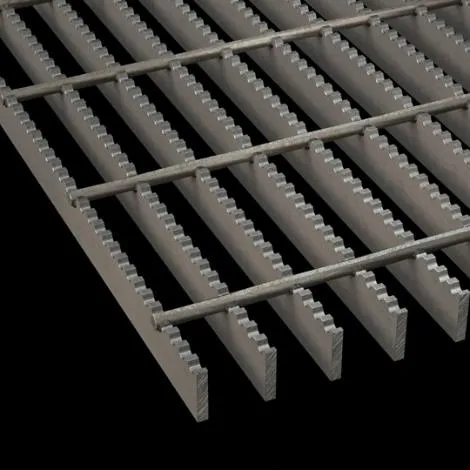
Anti-slip serrated teeth bite wet or oily soles. Fewer slips.
Itemized quote within 24 hours · Free drawing review included
In-house weld & press lines
Serrated and close-mesh panels under one roof
Certified & tested
Reports on request, MTC with every order
Samples in 5–7 days
Production in 15–25 working days
FOB Tianjin
Shipped worldwide, EXW / CIF negotiable
Anti-slip types compared
Three Routes to an Anti-Slip Surface: Serrated, Close-Mesh or Grit
There is no single "anti-slip grating" — there are three geometry routes, each solving a different zone. Anti-slip here means surface design, not a test rating. Here is how the routes compare, with an honest note on where each one comes from.
| Dimension | Serrated topsDefault | Close-mesh plain | Surface grit coating |
|---|---|---|---|
| Gripping principle | Teeth sheared into the bearing-bar top bite into wet or oily soles | More bars underfoot — smaller openings put more steel edges in contact with the sole | Mineral grit in a bonded layer interlocks with the sole tread |
| Typical geometry | Serrated or plain tops on 20×3 – 100×8 mm bearing bars | Press-locked mesh down to 11 / 11 mm openings | Coating applied over a plain or serrated panel surface |
| Best suited zones | Wet floors, outdoor stairs, ramps and frost-prone walkways | Pedestrian traffic, washdown areas, heel-sensitive floors | Oily and greasy floors where steel alone stays slick |
| Drainage & cleaning | Open mesh sheds water; teeth release packed frost and debris | Fine slots still drain; light debris stays on top for sweeping | Grit can hold a grease film — needs a scheduled cleaning cycle |
| Heel behavior | Openings sized so heels bridge the bars | 11 / 11 mm openings keep heels and wheels on the surface | Continuous coated surface — no openings to trap heels |
| Our supply | In-house — serrated variants on our welded and press lines | In-house — press-lock machine runs close mesh | Site-applied option we can accommodate per project — not a coating line we run |
Not sure which route fits your zone? Send your drawings — we will spec it inside the 24-hour quote.
How each route grips
The Mechanics Behind a Non-Slip Grating Surface
1 · Serrated teeth
The top edge of each bearing bar is sheared into teeth. Under load the sole deforms over the tooth profile, so the steel interlocks with the shoe instead of riding on a flat surface — the same effect wet or dry.
2 · Close-mesh plain
With openings down to 11 / 11 mm, a press-locked panel puts many more bar edges under the same footprint. The sole always lands on steel edges, and heels or small wheels cannot drop into the mesh.
3 · Grit coating
A bonded mineral layer turns any panel — plain or serrated — into a rough walking surface. It is applied on site, and we can accommodate it per project; it is not a coating line we run in the workshop.
Why specify anti-slip
Why Specifiers Choose Anti-Slip Bar Grating
A surface that grips
Anti-slip serrated teeth bite wet or oily soles — fewer slips, fewer incidents on site, and a walking surface that behaves the same on a rainy ramp as on a dry platform.
Serrated or plain, cut to your sizes
Anti-slip surfaces, serrated or plain, in any panel size — custom anti-slip grating cut and banded to your drawings, with free drawing review inside the 24-hour quote.
Stairs and heavy-duty floors
Anti-slip grating for stairs — serrated treads with nosing options — plus heavy-duty anti-slip panels with thicker bars and closer centers where wheels meet the floor.
Zone chooser
Choosing Non-Slip Grating by Zone: Wet, Oily, Frost, Ice
Start from what lands on the floor, then pick the geometry. These are design recommendations — the route we would spec for each exposure in your quote.
Wet zones
Washdown areas, rain-exposed platforms, process floors. Serrated tops are the default route — water drains straight through the open mesh while the teeth keep their bite.
Oily zones
Mills, workshops, press pits. Pair serration with a closer mesh for more edges underfoot, or plan a site-applied grit coating — accommodated per project on request.
Frost zones
Outdoor stairs, ramps, escape routes. Serrated teeth break the thin frost film that forms overnight, and the open mesh sheds melt water instead of pooling it underfoot.
Ice zones
Winter yards, freezer thresholds, exposed bridges. Combine serration with closer centers so the sole always meets toothed steel, and budget de-icing access into the fixing layout.
Specifications
Anti-Slip Grating Specifications
| Parameter | Range |
|---|---|
| Bearing bar | 20×3 mm to 100×8 mm, plain or serrated tops |
| Bar spacing | 30 / 40 / 60 mm centers (welded) · down to 11 / 11 mm (press-locked) |
| Cross bar | Twisted square or round, per specification |
| Panel width | Up to 1.25 m |
| Panel length | Up to 6 m |
| Materials | Q235B carbon steel · SS304 / SS316 stainless |
| Surface | Black or hot-dip galvanized (ASTM A123 / ISO 1461) |
| Anti-slip routes | Serrated tops · close-mesh plain · grit coating accommodated per project |
Materials & test documents
Anti-slip is geometry — the paperwork covers the steel and the coating behind it. Every heat of Q235B, SS304 or SS316 enters production with its mill test certificate verified at goods-in, the first of our five QC stages. Panels leave with documentation, not promises:
- Mill test certificate to EN 10204 Type 3.1
- Factory inspection report with every shipment
- Declaration of Conformity prepared per order destination
Standards & compliance
Produced to Recognized Standards — Documents on Request
ANSI / NAAMM MBG 531
Panels produced to MBG 531 reference practice, with weld and joint inspection on our five-stage QC plan.
ASTM A123 / ISO 1461 HDG
Galvanized coating thickness checked by sampling on every galvanized batch before panels are released.
CE & SGS tested
Certified & tested, reports on request — material and coating documents you can verify, not a certificate wall.
Custom made
Custom Sizes, Cut and Banded to Your Drawings
Send your drawing
Panel sizes, zone exposure (wet, oily, frost or ice), quantities — or just photos and a sketch. Drawing review is free.
Quote within 24 hours
Itemized, FOB Tianjin as standard — EXW or CIF on request. The route recommendation for your zone is included. Small trial orders welcome.
Samples in 5–7 days, production in 15–25
Working days after drawing confirmation, hot-dip galvanizing included. Installation drawings and fixing layout ship with the order.
Factory-direct quote
Get a Factory Quote
Send your zone, panel sizes and quantities — an itemized quote with a recommended anti-slip route lands within 24 hours. Ask for your anti-slip quote today: samples are ready in 5–7 days.
- Five-stage QC, from MTC verification at goods-in to final inspection
- DoC, MTC EN 10204 3.1 and inspection report with every order
- Factory audits welcome — see the lines before you commit
Prefer to talk? WhatsApp us or sales@dtsteelladder.com
Request your quote
Five fields — we do the rest.
FAQ
Frequently Asked Questions
Which anti-slip route suits a wet or oily area?
For wet zones, serrated bearing-bar tops are the default — the teeth bite into wet or oily soles. For oily zones, pair serration with a closer mesh, or specify a site-applied grit coating, which we can accommodate per project. We recommend a route for your zone inside the 24-hour quote.
Do you supply slip-resistance test reports?
No. Anti-slip on this page is surface geometry, not a tested rating, and we do not claim slip-test certificates. What arrives with every order is material documentation: a mill test certificate to EN 10204 Type 3.1, the factory inspection report and a Declaration of Conformity — certified and tested, reports on request.
What sizes and lead times apply to anti-slip grating?
Bearing bars run from 20×3 mm to 100×8 mm, plain or serrated, with press-locked close mesh down to 11 / 11 mm, and panels up to 1.25 m wide and 6 m long, cut to your drawings. Samples ship in 5–7 working days, production runs 15–25 working days after drawing confirmation, and your quote lands within 24 hours.
Related pages
Related Safety Grating Pages
Safety Grating
The safety line overview — surface and edge options in one place.
View page →Serrated Grating
Serration fundamentals — how the tooth works, in mechanics terms.
View page →Non-Slip Metal Grating
Non-slip selection guide by wet, oil and frost zone.
View page →Heel-Proof Grating
Close-mesh geometry that keeps heels on the surface.
View page →Pedestrian Grating
Pedestrian duty — heel-proof spacing and walking comfort.
View page →Serrated Bar Grating
Serration applied to bar grating construction, panel by panel.
View page →