Factory-direct steel gratings & stair treads, shipped worldwide
Grating Load Calculator Excel
Need load calculator? Factory engineers send full data free.
Verified span & load data in spreadsheet form · Returned with your 24-hour quote
Spreadsheet data from factory engineers
Checked against the panels we actually build
Certified & tested
Reports on request, MTC with every order
Samples in 5–7 days
Production in 15–25 working days
FOB Tianjin
Shipped worldwide, EXW / CIF negotiable
Honest position
Why This Page Has No Download Button
You searched for a grating load calculator Excel file, and plenty of sites will hand you one. We do not publish a self-serve workbook, because a spreadsheet full of hardcoded tables is only as good as the span, support condition and deflection limit baked into its formulas — assumptions only your project knows. One wrong input cell quietly buys the wrong steel. Here is what we do instead, three ways:
See what the sheet contains
The full anatomy of a proper load workbook — inputs tab, bar schedule, span lookup, deflection check — laid out so you can judge any spreadsheet, ours included. Read the layout →
Build your own sanity-check sheet
Three relationships carry the whole calculation. We give you the method, openly — then your own workbook becomes a checker, not a guesser. Get the method →
Request our verified data
Span and load tables for your exact case, compiled by factory engineers and provided in spreadsheet form on request — free, with your quote. Request the data →
Anatomy of the sheet
What a Grating Load Calculator Spreadsheet Contains
A load calculator workbook worth trusting is not one magic formula — it is five connected tabs. This is the layout our engineers work to, and the structure to demand from any sheet you are handed. The ranges below are the ones this mill actually builds to; the load numbers themselves come with your request, not published as generic tables.
| Workbook tab | What lives there | Where the numbers come from |
|---|---|---|
| Inputs | Clear span and bearing direction, bar spacing, uniformly distributed load, concentrated load, material and finish | Your project values — the only cells you edit |
| Bar schedule | Bearing bar depth × thickness with spacing options, per designation | Our real range: 20×3 mm to 100×8 mm bars at 30 / 40 / 60 mm centers |
| Span × load lookup | The span table crossed with bar section and load type — uniform and point load checked separately | Standard beam theory, referenced to ANSI / NAAMM MBG 531 practice |
| Deflection check | Calculated sag compared with the limit your project sets, usually a fraction of span | Your governing code — this tab usually picks the section |
| Output | Nearest passing bar section, panel weight estimate, and the honest pass-or-check flag | Formulas above, nothing hand-typed |
The same structure doubles as a grating span calculator — hold the load fixed and read how far each section carries it — and, with one extra column, as a grating weight calculator on the area × steel basis. Related pages: reading a grating load table and the 19W4 load table family.
The method
Build Your Own Sanity-Check Sheet
Any grating load calculator — Excel, paper or the back of a drawing — runs on three relationships. Put them in three rows of a spreadsheet and you have a checker that catches wrong answers from fancier tools.
1 · Strip: load per bar
One bearing bar carries the strip of floor one spacing wide, so per-bar load is simply the area load times the spacing. Wider centers mean each bar collects more floor — which is why heavy duty usually means closer bars as well as deeper ones.
2 · Section: depth before thickness
A rectangular bar's bending resistance grows with the square of its depth but only in proportion to its thickness — so when a check fails, the answer is a deeper bar, not a thicker one. Our range steps from 20×3 mm to 100×8 mm.
3 · Sag: span is unforgiving
Under uniform load, deflection grows with the fourth power of span — double the span and the same bar sags sixteen times more. The deflection limit your code sets usually governs the selection before strength does.
One more column makes it a weight sheet
Panel weight follows the same logic as a per-area estimate: steel in the bars per square metre, driven by bar section and spacing, then multiplied by your panel area. Add that column and the same workbook doubles as a grating weight calculator for budgeting freight and support steel. For the verified per-designation numbers, ask for the spreadsheet data with your quote.
Two tools, two jobs
Your Sanity-Check Sheet vs Our Verified Data
These are not competitors — they check each other. Build the first, request the second, and the answer only counts when they agree.
| Dimension | A sheet you build | Verified data from this mill |
|---|---|---|
| Best at | Catching order-of-magnitude errors, comparing options quickly | Selecting the section you actually order |
| Numbers used | Beam-theory relationships and whatever section data you enter | Real product data for bars 20×3 to 100×8 mm, 30 / 40 / 60 mm centers, MBG 531 referenced |
| Load cases | The ones you remember to include | Uniform and point loads both checked, worst position included |
| Deflection limit | Whatever you assume | Set to your project's code, checked explicitly |
| Where it can mislead | Wrong span direction, forgotten point load, generic table pasted in | Only if your inputs are wrong — engineers ask before assuming |
Want the verified side of that table? Send your spans and loads — the spreadsheet data comes back with your quote.
Why ask this factory
Why Engineers Get Their Load Data From This Mill
Factory load calculator data, free
The numbers come from the mill that cuts the bars, not from a template. Span and load data for your case is compiled by factory engineers and sent free, in spreadsheet form, with your quote.
Pro help, not an auto-guesser
Send spans, loads or just a sketch and engineers reply within 24 hours — checking your inputs before running numbers, because the right question is half the calculation.
The sheet made simple
Five tabs and three relationships — that is the whole tool. This page hands you the structure and the method, so any load data you receive can be checked, not just trusted.
Specifications
The Ranges the Spreadsheet Draws From
| Parameter | Range |
|---|---|
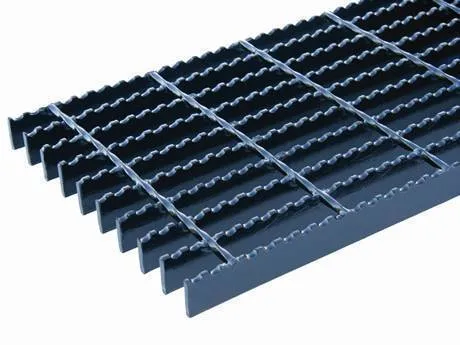
| Bearing bar | 20×3 mm to 100×8 mm, plain or serrated |
| Bar spacing | 30 / 40 / 60 mm centers |
| Cross bar | Twisted square or round, per specification |
| Panel width | Up to 1.25 m |
| Panel length | Up to 6 m |
| Materials | Q235B carbon steel · SS304 / SS316 stainless |
| Surface | Black or hot-dip galvanized (ASTM A123 / ISO 1461) |
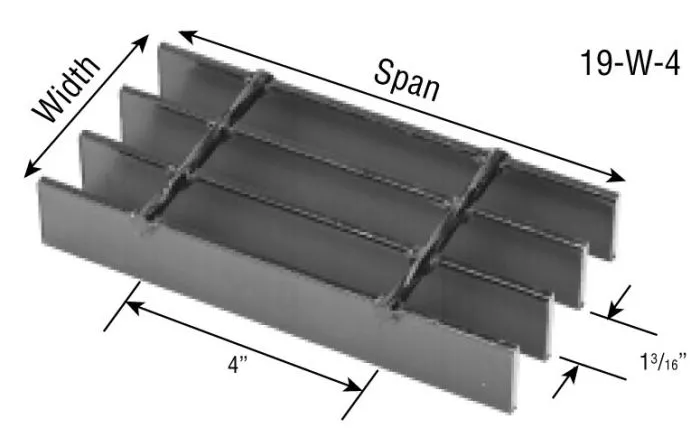
| Stock designation | 19W4 and custom equivalents |
How the verified data reaches you
Span tables, load tables and unit weights for your designation are provided with your quote — in spreadsheet form on request — because the right table depends on your span and load case, so we do not publish generic ones. The documents travel with the steel:
- Mill test certificate to EN 10204 Type 3.1
- Factory inspection report with every shipment
- Declaration of Conformity prepared per order destination
Standards & compliance
Data Referenced to Recognized Practice — Documents on Request
ANSI / NAAMM MBG 531
Span and load data referenced to MBG 531 practice, on the designation you specify — 19W4 or a custom equivalent.
ASTM A123 / ISO 1461 HDG
Galvanized coating thickness checked by sampling on every galvanized batch before panels are released.
CE & SGS tested
Certified & tested, reports on request — we show documents you can verify, not a certificate wall.
Ask the factory
Request the Spreadsheet — It Comes Back With Your Quote
Send spans, loads or a sketch
Clear span and bearing direction, uniform and point loads, bar section if known. Drawings and photos are perfect — review is free.
Engineers compile the verified data
Span and load tables for your designation — bars 20×3 to 100×8 mm, Q235B or SS304 / SS316 — with uniform and point cases both checked.
Spreadsheet data within 24 hours
Returned with your itemized quote, FOB Tianjin as standard — EXW or CIF negotiable. Samples in 5–7 working days; production in 15–25.
Free spreadsheet data
Request the Verified Load Spreadsheet
This form is the spreadsheet request: list your spans and loads in the details field, and factory engineers compile the verified span and load data for your case, sending it in spreadsheet form with your itemized quote within 24 hours.
- Verified span and load data, free, in spreadsheet form
- Uniform and point load cases both checked by factory engineers
- DoC, MTC EN 10204 3.1 and inspection report with every order
Prefer to talk? WhatsApp us or sales@dtsteelladder.com
Ask for the load spreadsheet
Five fields — we compile the data.
FAQ
Frequently Asked Questions
Can I download a grating load calculator Excel file here?
No — and that is deliberate. A self-serve workbook full of hardcoded tables is only as good as the span, support and code assumptions baked into it, and one wrong input cell quietly buys the wrong steel. Instead, factory engineers send the verified span and load data for your case, in spreadsheet form, with your 24-hour quote.
What should a grating load calculator spreadsheet contain?
Five parts: an inputs tab for clear span, bar spacing, uniform and point loads, and material; a bar schedule of h × b sections and centers; a span-table lookup organized by bar section and load type; a deflection check against your project's limit; and an output tab that flags the nearest passing section — with uniform and point loads both checked.
How do I build my own grating load sanity-check sheet?
Three relationships carry it. One bar carries the strip of floor one spacing wide, so per-bar load is the area load times the spacing. A rectangular bar's bending resistance grows with the square of its depth, so deepen before you thicken. And deflection grows with the fourth power of span, so the sag limit usually governs — our range runs 20×3 mm to 100×8 mm bars at 30 / 40 / 60 mm centers.
Related pages
Related Specification & Calculator Pages
Grating Load Calculator
The grating-wide method page: loads, codes and how a check is run.
View page →Bar Grating Load Calculator
The bar-grating method: strip, section and sag, applied to your numbers.
View page →Grating Load Table
Reading a grating load table: rows, columns and limits.
View page →19W4 Load Table
Load table data for the 19W4 designation family.
View page →Grating Deflection Calculator
Deflection usually governs — how the sag limit drives bar depth.
View page →Technical Resources
The technical hub: tables, calculators and buying guides in one place.
View page →