Factory-direct steel gratings & stair treads, shipped worldwide
Grating Deflection Calculator
Strength calculator help from a real grating mill. Free and fast.
No widget, no guessed numbers — our engineers run the deflection check and return it with your quote within 24 hours.
Reply within 24 hours
Deflection results returned with your quote
Certified & tested
Reports on request, MTC with every order
A real grating mill
3,000 ㎡ workshop, 4 product lines under one roof
FOB Tianjin
Shipped worldwide, EXW / CIF negotiable
The deflection method
What a Deflection Check Actually Measures
A grating strength calculator answers two different questions. Strength asks whether the panel holds the load without failing. Deflection asks how far the panel bends under that load. Both matter — but for floors people walk on, the deflection side usually decides the specification, because a floor can be amply strong and still feel springy underfoot.
A deflection limit is the allowed movement, set by your code, client specification or simply by comfort: keep the floor stiff enough that people do not notice it moving, that walking feels solid, and that vibration from footfall or machinery stays imperceptible. It is a serviceability check, not a safety-margin check — and it depends on the load pattern, which is why the first question we ask is always the same:
| Load pattern | Uniform (distributed) load | Concentrated (point) load |
|---|---|---|
| What it models | Weight spread across the whole floor area — people walking, stored goods, snow on an outdoor platform | A single footprint, a wheel, a pallet foot or a machine leg acting on one spot |
| How the panel responds | A gentle, even sag along the whole span — the classic floor comfort case | A sharper local dip between bearing bars and supports, concentrated near the load |
| Typical governing concern | Overall floor stiffness, comfort and vibration underfoot | Local bending of single bars and the clear-opening span the load crosses |
| What you send us | Area load value with units, span between supports, bar specification if known | Point load value, contact or footprint size, position on the span |
| Where it usually governs | Walkways, mezzanines, storage platforms, roof walkways | Trench and driveway covers, dock areas, floors crossed by trolleys |
The two checks can disagree, which is exactly why a one-box widget misleads: the panel that wins the strength comparison is not automatically the one that passes the deflection limit. Send us both load patterns — we run the deflection checks and return them with your quote within 24 hours.
Stiffness physics
What Drives Deflection: Span and Bar Depth
Three geometry decisions dominate how much a grating panel bends — the same physics that drives any steel grating calculator, stated here qualitatively because honest deflection numbers only come from your actual span and load.
1 · Span length leads
Sag grows disproportionately with span: support the same panel on a slightly longer clear opening and the movement grows far faster than the extra length. Cutting the span in half — one more support beam — is usually the cheapest stiffness you can buy.
2 · Bar depth beats thickness
Bearing bars work on edge, and stiffness climbs steeply with depth: a taller bar of the same thickness is many times stiffer, while adding thickness buys far less. That is why deflection problems are usually solved by going from a shallow to a deeper bar, not by adding steel everywhere.
3 · Spacing and support width
Closer bearing bar centers put more bars under the same load, so each bar carries less and bends less. Wider support seats and continuous spans over two or more beams stiffen the panel again. Spacing is also the lever that trades stiffness against open area and weight.
Material choice sets the ceiling — stainless and carbon steel of the same section behave alike in stiffness terms, so geometry, not grade, is where deflection is won. Bring us the span and load and we will tell you which combination clears your limit: we run deflection checks and return them with your quote.
Calculator help, the honest way
Free Strength Calculator Help From a Real Mill
Free and fast — no widget to trust
Strength calculator help from a real grating mill. You send the numbers; our engineers run the load and deflection checks and explain the result in plain language. Nothing to download, nothing to mis-key.
Answers by email, pro help behind them
Ask for deflection and load tables by email and the reply lands within 24 hours. The people answering run the welding and press-locking lines for the panels you are specifying.
Checked against what we actually build
Every check is run against our real production range — bearing bars from 20×3 mm to 100×8 mm at 30 / 40 / 60 mm centers — so the answer you get is a panel we can ship, not a theoretical alloy on a chart.
Where it matters
Where Deflection Governs the Floor Spec
Anywhere people walk, sit or work on steel, the deflection limit — not the failure load — is usually what sizes the panel. Four typical cases:
Pedestrian walkways
Comfort is the driver: a walkway that passes strength can still feel live underfoot. Stiffer spans keep footfall unnoticeable.
Mezzanines & storage floors
Steady distributed loads plus people: deflection limits stop visible dips and keep equipment from rocking on a soft floor.
Trench & driveway covers
Wheels concentrate load over a clear opening — the span. Deflection and local bar bending decide the cover, not just the strength rating.
Stair treads
A single footfall on one tread is a point load. Tread span and end-plate fixing decide whether the step feels dead or springy.
The range the checks run against
Our Real Production Range
| Parameter | Range |
|---|---|
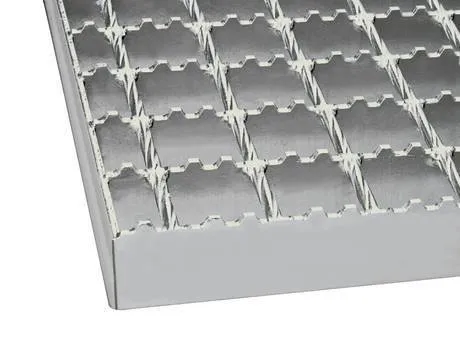
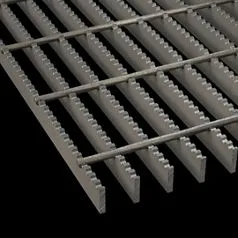
| Bearing bar | 20×3 mm to 100×8 mm, plain or serrated |
| Bar spacing | 30 / 40 / 60 mm centers; press-locked close mesh down to 11 / 11 mm |
| Cross bar | Twisted square or round, per specification |
| Panel width | Up to 1.25 m |
| Panel length | Up to 6 m |
| Materials | Q235B carbon steel · SS304 / SS316 stainless |
| Surface | Black or hot-dip galvanized (ASTM A123 / ISO 1461) |
| Forming | Electro-forged welded; press-locked close mesh |
How the numbers reach you
We do not publish fixed deflection tables, because a table that ignores your support conditions would be guesswork. Instead, we run deflection checks panel by panel against the range above and return them with your itemized quote. Every order ships with documentation, not promises:
- Mill test certificate to EN 10204 Type 3.1
- Factory inspection report with every shipment
- Declaration of Conformity prepared per order destination
Standards & compliance
Produced to Recognized Standards — Documents on Request
ANSI / NAAMM MBG 531
Panels produced to MBG 531 reference practice — the same convention load and deflection tables are built on, with weld inspection on our five-stage QC plan.
ASTM A123 / ISO 1461 HDG
Galvanized coating thickness checked by sampling on every galvanized batch — the finish dimension that stays constant while the bars get stiffer.
CE & SGS tested
Certified & tested, reports on request — we show documents you can verify, not a certificate wall.
From numbers to numbers
Send Span and Load — the Deflection Check Comes Back With Your Quote
Send your span and load
Clear span between supports, load pattern and values, bar specification if known — or just a sketch. Drawing review is free.
We run the deflection check
Engineers verify span, bar depth and spacing against your limit, then quote the panel that clears it — itemized, FOB Tianjin as standard, EXW or CIF on request.
Results with your quote, in 24 hours
Deflection results and the quoted panel arrive together. Samples ship in 5–7 working days; production runs 15–25 working days after drawing confirmation.
Factory-direct quote
We Run the Deflection Check — You Get the Numbers
Ask for deflection and load tables by email, or send the form — either way the numbers come back with your itemized quote within 24 hours.
- Checks run against our real bar range: 20×3 mm to 100×8 mm, 30 / 40 / 60 mm centers
- DoC, MTC EN 10204 3.1 and inspection report with every order
- Factory audits welcome — see the lines before you commit
Prefer to talk? WhatsApp us or sales@dtsteelladder.com
Request your deflection check
Five fields — we run the numbers.
FAQ
Frequently Asked Questions
Do you provide a grating deflection calculator I can use myself?
We do not publish a self-service widget. Deflection depends on your exact span, load pattern and bar specification, so we run the check on our side: send your numbers and the deflection results come back with your itemized quote within 24 hours.
What is the difference between a load check and a deflection check?
A load check asks whether the panel is strong enough not to fail; a deflection check asks how far it moves under that load. A floor can pass the first and still feel springy underfoot, so pedestrian floors are usually governed by the deflection side, not by strength alone.
What information do you need to run a deflection check?
Span between supports, load type (uniform or concentrated) with values, bearing bar size and spacing if already specified, and the material. A sketch or drawing helps — drawing review is free inside the 24-hour quote.
Related pages
Related Specification & Calculator Pages
Grating Load Calculator
The strength side: how much load a panel carries before the deflection question even starts.
View page →Bar Grating Load Calculator
Bar-by-bar load method for bar grating panels.
View page →How To Calculate Grating Load
The step-by-step load method, made simple.
View page →Grating Maximum Span Length
How far a panel can span before deflection, not strength, sets the limit.
View page →Grating Load Table
Reading load tables: spans, bar sizes and what the rows assume.
View page →Grating Load Calculator Excel
Spreadsheet workflow for engineers who keep their own sheets.
View page →