Factory-direct steel gratings & stair treads, shipped worldwide
19W4 Load Table
19w4 load table? Get factory data and charts, free.
The verified table sheet arrives with your 24-hour quote · Free drawing review included
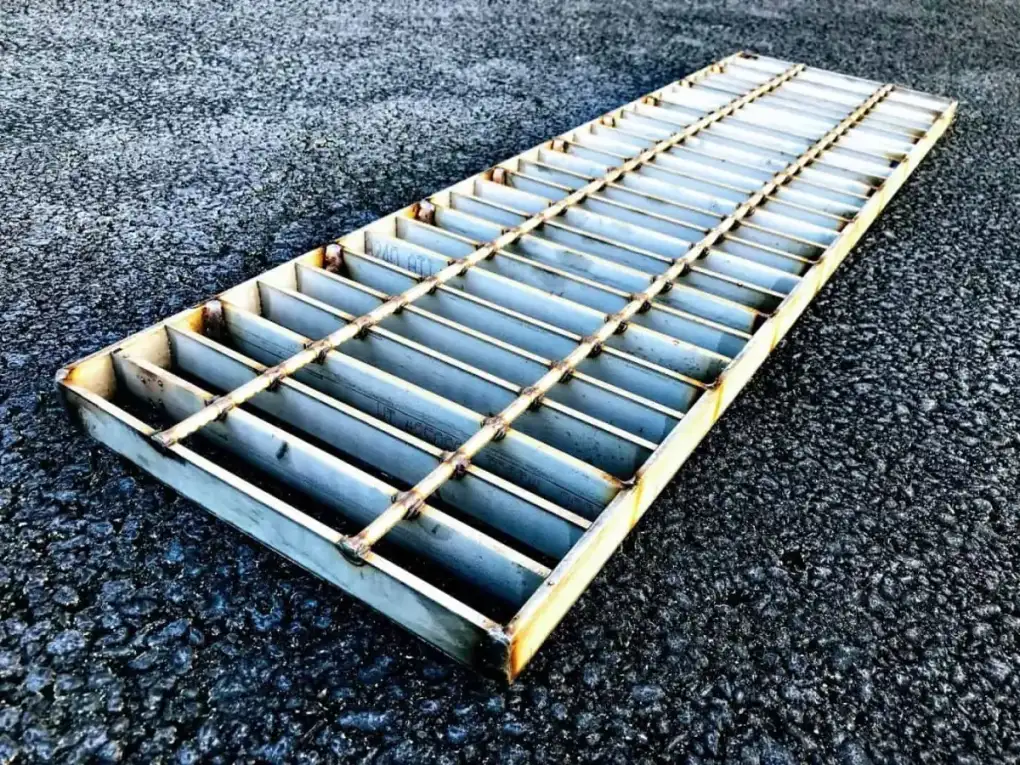
3,000 ㎡ workshop, 4 product lines
Data checked against bars we actually weld
Certified & tested
Reports on request, MTC with every order
Quote within 24 hours
Table sheet and bar-size advice included
FOB Tianjin
Factory-direct worldwide, EXW / CIF negotiable
Read the designation first
What 19W4 Says — and What the Load Table Adds
A load table only makes sense once you know what the designation fixes, and what it deliberately leaves open. Here is the anatomy, then the reading method — the numbers themselves travel with your quote, because they depend on inputs only you can confirm. Whether you call it a 19W4 load chart or a bar grating load chart — or a bar grating load table — the data behind the name is the same: safe uniform and concentrated loads for the clear span you are actually spanning.
Bearing bar spacing
Stated in sixteenths of an inch: 19/16 in, i.e. 1-3/16 in — about 30 mm centers, the closest pitch in our welded line, where bar spacing runs 30 / 40 / 60 mm.
Welded construction
The construction letter: W for electro-forged welded panels, P for press-locked, R for riveted. Construction changes joint stiffness, so tables are per construction type.
Cross bar spacing
Stated in whole inches: 4 in, about 100 mm. Cross bars stabilize the bearing bars; they rarely carry the load, which is why table values track bearing bar size.
How a 19W4 load table is laid out
| Table element | What it means |
|---|---|
| Rows = span | The clear distance between supports, measured parallel to the bearing bars. Start at your support spacing, not at the panel length. |
| Column family 1 | Uniformly distributed load (UDL), listed per unit area — the everyday case for floors and platforms. |
| Column family 2 | Concentrated (point) load, usually at midspan — the worst single position for a wheel or a pallet foot. |
| Header = bar size | Depth × thickness of the bearing bar. 19W4 alone does not fix this, so the table is really a family of tables, one per bar size. |
| Footnote = deflection basis | The deflection limit the values were computed to. Change the basis and every number in the row changes with it. |
Deflection limits are a design choice
Two identical 19W4 panels on the same span can carry different loads — because their tables were computed to different deflection limits. A limit is usually stated as a fraction of the span, and that fraction is chosen by the project: a mezzanine floor, a pedestrian catwalk and a vehicle crossing each accept a different amount of sag.
So when you compare tables from two suppliers, always compare the deflection basis first. A bigger number on a looser basis is not more capacity — it is a different question.
Send your span and deflection basis — engineers reply within 24 hours
The two column families
Uniform or Concentrated: Which Column Governs Your Span?
Every 19W4 load table splits its columns between these two load types. A panel must pass both at your span — whichever is harder wins.
1 · Span sets the row
Span is the clear distance between supports, measured along the bearing bars. Bearing bars run across the opening; load travels along them to the steel below.
2 · Uniform load (UDL)
Spread evenly across the surface: people, stored goods, snow. Listed per unit area, so you multiply by your tributary area and compare with the row for your span.
3 · Concentrated load
Acts at one point, tabulated at midspan where it bends the panel hardest: a forklift wheel, a pallet foot, a jack stand. Listed as a single force, not per area.
Fix your span
Measure support-to-support along the bearing bars and find that row.
Check both load types
Compare UDL and concentrated values against your duty — the lower margin governs.
Pick the bar size
Move to a deeper or thicker bearing bar until both checks pass at your deflection basis.
Why engineers ask us for data
Free Data, Checked by the Factory That Welds the Bars
Free, and sent by email
The reading guide on this page is free, and the full 19W4 load table sheet is sent with your quote — no drip campaign, no gated webinar, just the data.
Answered by factory engineers
Send your span and load question and an engineer — not a chatbot, not a reseller — replies within the 24-hour quote window with the matching table section.
Made simple, on purpose
Span, load type, bar size. If a load table cannot be read in three steps, it was written wrong — our sheet keeps the same layout you see explained above.
Applications
Where a 19W4 Load Table Gets Used
Same designation, different governing column. These are the four duties where knowing which load type rules saves a redesign.
Platforms & mezzanines
Uniform load usually governs — stored goods and foot traffic spread across the panel area.
Walkways & catwalks
At long spans a single concentrated load can govern even with light uniform traffic — check both columns.
Trench covers with traffic
A wheel crossing midspan is the concentrated column at its worst — close-mesh variants help heel safety, not load.
Stair treads
Treads see a point load at the nosing, so tread data is tabulated separately from flat-panel tables.
Specifications
The Range Behind the Table — What We Actually Weld
| Parameter | Range |
|---|---|
| Designation family | 19W4 and custom equivalents (W-19-4 style) |
| Bearing bar | 20×3 mm to 100×8 mm, plain or serrated |
| Bar spacing | 30 / 40 / 60 mm centers |
| Cross bar | Twisted square or round, per specification |
| Panel width | Up to 1.25 m |
| Panel length | Up to 6 m |
| Materials | Q235B carbon steel · SS304 / SS316 stainless |
| Surface | Black or hot-dip galvanized (ASTM A123 / ISO 1461) |
| Load table sheet | Provided with your quote, per bar size and deflection basis |
How the full 19W4 load table reaches you
19W4 load tables are provided with your quote — ask in the message field. The sheet lists every bar size we weld in the 19-series, span by span, with the uniform and concentrated columns side by side and the deflection basis stated up front.
- Send your span, load and deflection basis — engineers reply within 24 hours
- Values checked against bars we weld daily — no reseller copy-paste
- Sample panels in 5–7 working days to verify the choice on site
Standards & compliance
Tables Compiled to Recognized Practice — Documents on Request
ANSI / NAAMM MBG 531
The 19W4 designation and load-table layout follow standard industry practice referenced in MBG 531. Panels are produced to your specified bar size, span and finish.
ASTM A123 / ISO 1461 HDG
Hot-dip galvanized finish for outdoor duty, with coating thickness checked by sampling on every galvanized batch before release.
CE & SGS tested
Certified & tested, reports on request. Mill test certificates to EN 10204 Type 3.1 and the factory inspection report travel with every order.
From table to order
Three Steps From a Span to a Shipped Panel
Send span, load and deflection basis
Or just the drawing — panel sizes, bar spec, quantities. Drawing review is free and happens inside the quote window.
Quote within 24 hours, table attached
Itemized, FOB Tianjin as standard — EXW or CIF on request. The full 19W4 load table sheet comes with it, plus the bar size we recommend.
Samples in 5–7 days, production in 15–25
Working days after drawing confirmation, hot-dip galvanizing included. Installation drawings and fixing layout ship with the order.
Free data, then a quote
Get the 19W4 Load Table
Send your 19w4 load table questions — factory reply in 24 hours. Ask for the table in the message field and the sheet arrives with your quote.
- Full sheet: every 19-series bar size, span by span, both load types
- Deflection basis stated, so tables from two suppliers compare fairly
- Factory audits welcome — see the lines before you commit
Prefer to talk? WhatsApp us or sales@dtsteelladder.com
Request the table sheet
Five fields — we do the rest.
FAQ
Frequently Asked Questions
What does 19W4 mean on a load table?
19W4 is an industry designation: 19 is the bearing bar spacing in sixteenths of an inch (19/16 in, about 30 mm), W is welded construction, and 4 is the cross bar spacing in whole inches (4 in, about 100 mm). The designation does not fix the bar depth or thickness, so a 19W4 load table is always read together with the bar size it was computed for.
Can I get the full 19W4 load table as a file?
Yes. The verified table is provided with your quote rather than published as fixed numbers, because the values depend on bar size, span and deflection limit. Ask for it in the message field of the form below and factory engineers send the sheet with your 24-hour quote.
What is the difference between uniform and concentrated load in the table?
Uniform load spreads over the whole panel surface and is listed per unit area — people, stored goods, snow. Concentrated load acts at one point, usually midspan, and is listed as a single force — a wheel or a pallet foot. A 19W4 panel must pass both checks at your span, whichever governs.
Related pages
Related Specification & Calculation Pages
19W4 Steel Grating
The designation as a product — bar sizes, finishes and custom equivalents we weld.
View page →W-19-4 Grating
The same designation written with the construction letter first — panel specs and sizing.
View page →Grating Load Table
The designation-independent view: how grating load tables are built for any series.
View page →How To Calculate Grating Load
The method behind the cells — from load case to required section, step by step.
View page →Bar Grating Load Calculator
Run your span and load through a calculation instead of reading a static table.
View page →Grating Maximum Span Length
How far a panel can bridge between supports before the next bar size is needed.
View page →