Factory-direct steel gratings & stair treads, shipped worldwide
25x5 Grating Unit Weight
Factory engineers share unit weight data, free by email.
25×5 mm sits inside our real 20×3–100×8 mm bearing-bar range · Verified sheet provided with your quote
3,000 ㎡ workshop, 4 product lines
Welded, press-locked, treads and stainless under one roof
Certified & tested
Reports on request, MTC with every order
Engineers reply in 24 hours
Unit weight data and quotes, itemized
FOB Tianjin
About 400 km to port, shipped worldwide
The calculation method
How 25x5 Grating Unit Weight Is Calculated
Grating is priced, shipped and supported by weight, so the number has to be honest. Rather than quoting one figure copied from a random bar grating weight chart, here is the exact method our engineers use — the verified kg/m² values for your exact configuration come with your quote.
Unit weight = steel volume per m² × density
unit weight (kg/m²) = bar volume inside 1 m² of panel × 7,850 kg/m³
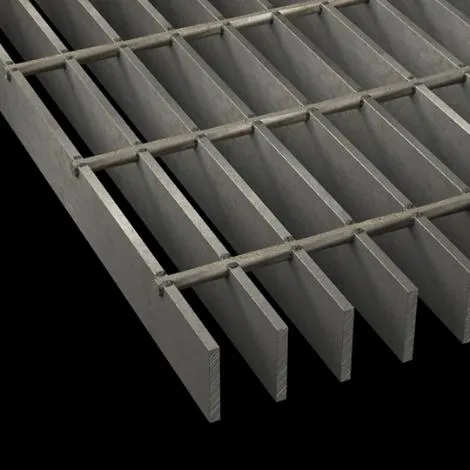
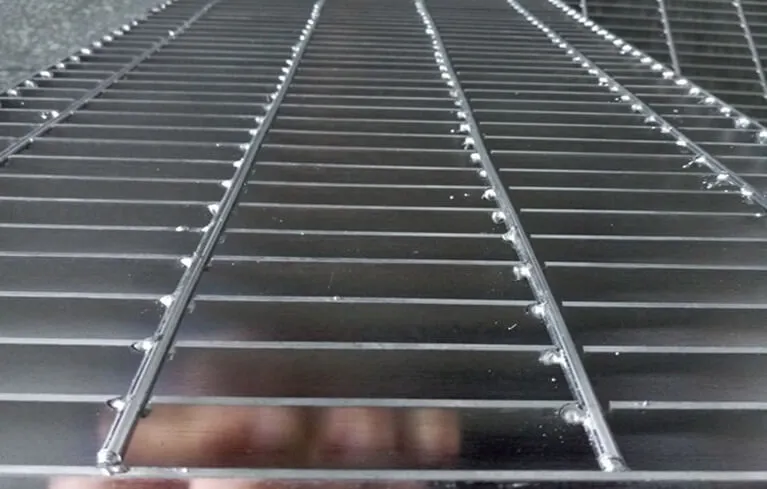
The bar volume is nothing mysterious — it is the steel you can count on the panel: how many bearing bars cross a metre of width (set by the pitch), the cross-section of each bar, and the length of bar held in that square metre, plus the cross bars and any banding.
Bars per metre — set by the pitch
At 30 mm centres roughly 33 bearing bars run through each metre of panel width; at 40 mm and 60 mm centres the count drops, and so does the steel. Pitch is the single biggest lever on unit weight.
Section area — 25 mm × 5 mm = 125 mm²
Every bearing bar contributes the same 125 mm² of steel. Taller or thicker bars raise weight fast, which is why heavy-duty panels use 40 mm, 50 mm and taller sections from the same range.
Cross bars and banding
Twisted square or round cross bars, their spacing, plus end banding and trim bars all add steel per m². On small panels the banded edges are a noticeable share of the total.
Density — 7,850 kg/m³ for carbon steel
Volume × 7,850 kg/m³ gives the theoretical unit weight in black Q235B. Stainless grades differ slightly, and hot-dip galvanizing adds a thin zinc coat on top — the sheet lists those variants separately.
| Weight driver | What it is on a 25×5 panel | Effect on unit weight |
|---|---|---|
| Bearing-bar pitch | 30 / 40 / 60 mm centres on our welded line | Closer pitch = more bars per metre = heavier panel |
| Bearing-bar section | 25×5 mm = 125 mm² of steel per bar | Taller or thicker sections add weight quickly |
| Cross-bar type & spacing | Twisted square or round bars, per specification | Heavier or more frequent cross bars add steel per m² |
| Banding & trim | End banding bars, trim and edge plates | Adds edge steel — most visible on small panels |
| Material grade | Q235B carbon steel, or SS304 / SS316 | Stainless densities differ slightly from carbon steel |
| Surface finish | Black, or hot-dip galvanized to ASTM A123 / ISO 1461 | Zinc coating adds a small amount of mass |
Want the verified values instead of the theory? Ask for the 25×5 unit weight sheet — it is provided with your quote, free.
Unit weight, made simple
Read Any Grating Weight Chart in Three Steps
1 · Confirm the designation
Check the bar section and the pitch before you read any row. A weight figure means nothing until you know it belongs to 25×5 mm bars at a stated spacing — the same bar at 30 mm and 60 mm centres gives two very different panels.
2 · Check cross bars and banding
Charts assume a construction. Twisted square versus round cross bars, cross-bar spacing, and whether panels are banded all shift the real number — note which construction a table assumes before trusting its kg/m².
3 · Apply panels and finish
Multiply by your real panel area and count the edge steel, then apply the finish. Black and galvanized panels differ by the zinc coat, and shipping weight is what the carrier actually bills.
Why the number matters
Why Engineers Care About 25x5 Grating Unit Weight
Unit weight is not trivia — it drives three commercial and structural decisions on every order.
Shipping cost
Ocean freight is billed by weight and volume. Accurate unit weight per m² turns a panel schedule into a realistic container plan ex Tianjin.
Handling on site
Per-panel weight decides whether two fitters can lift a panel or a crane is needed. Light 25×5 sections are often chosen exactly for manual installation.
Support loads
The grating's own weight is a permanent load on your structure. Dead load per m² feeds straight into beam and framing design.
Steel quantity & budget
Weight is how steel is bought. Unit weight × area gives the tonnage behind your itemized quote — per m² or per ton, FOB Tianjin.
Where 25×5 sits in our range
25×5 mm Is Inside Our Real Production Range
| Parameter | Range |
|---|---|
| Bearing bar range | 20×3 mm to 100×8 mm — 25×5 mm sits inside it, at the light end |
| Bar spacing | 30 / 40 / 60 mm centres |
| Cross bar | Twisted square or round, per specification |
| Panel width | Up to 1.25 m |
| Panel length | Up to 6 m |
| Materials | Q235B carbon steel · SS304 / SS316 stainless |
| Surface | Black or hot-dip galvanized (ASTM A123 / ISO 1461) |
| Close-mesh option | Press-locked panels down to 11/11 mm openings |
The 25×5 unit weight sheet — provided with your quote
We do not publish guessed numbers. The verified sheet is prepared by our engineers for the configuration you order and arrives with your itemized quote, free by email:
- A bar grating weight chart in kg — kg/m² for 25×5 mm at each pitch we run
- Per-panel shipping weights at common panel dimensions
- Black versus hot-dip galvanized values, side by side
- Imperial equivalents, so the same data works in lb/ft² projects
Request the unit weight sheet → · 19W4 designations explained → · Bearing bar options →
25×5 mm is a light section: fine for pedestrian walkways and light covers, but verify span and load before you commit. Heavier duty? Heavy-duty grating steps up the bar section from the same range.
Standards & compliance
Unit Weight You Can Check — Documents on Request
ANSI / NAAMM MBG 531
Welded panels produced to MBG 531 reference practice — the same designation logic your weight chart rows are built on.
ASTM A123 / ISO 1461 HDG
Galvanizing to referenced practice, with coating thickness checked by sampling on every galvanized batch — the finish that tips the weight sheet.
CE & SGS tested
Certified & tested, reports on request — plus MTC EN 10204 3.1 on every heat, verified at goods-in on our five-stage QC plan.
From data to order
From Unit Weight to a Priced Order
Send your panel schedule
Areas, spans, pitch and quantity — or just a sketch. Tell us black or galvanized; drawing review is free.
Quote and weight sheet within 24 hours
An itemized quote, FOB Tianjin as standard — EXW or CIF negotiable — with the 25×5 unit weight sheet attached.
Samples in 5–7 days, production in 15–25
Working days after drawing confirmation, hot-dip galvanizing included. Small trial orders welcome.
Free unit weight help
Get the 25×5 Unit Weight Sheet With Your Quote
Send your panel sizes and pitch — engineers reply within 24 hours with the itemized quote and the verified weight data, free by email.
- Weight data checked by Dengtai engineers, not scraped from a chart
- DoC, MTC EN 10204 3.1 and inspection report with every order
- Factory audits welcome — see the lines before you commit
Prefer to talk? WhatsApp us or sales@dtsteelladder.com
Request the sheet and quote
Five fields — we do the rest.
FAQ
Frequently Asked Questions
How much does 25x5 grating weigh per square metre?
There is no single fixed number — unit weight moves with bar pitch, cross-bar type and banding. It is calculated as the steel volume in one square metre (bars per metre × 125 mm² section × bar length) multiplied by the steel density of 7,850 kg/m³, and the verified kg/m² values for 25×5 grating are provided with your quote.
Is a 25×5 mm bearing bar inside your production range?
Yes. Our welded line runs bearing bars from 20×3 mm to 100×8 mm, so 25×5 mm sits inside the range at the lighter end. Bar spacing runs 30/40/60 mm and panels measure up to 1.25 m wide by 6 m long — confirm span and load with our engineers before finalizing.
Does hot-dip galvanizing change the unit weight?
It adds a thin zinc coating, so a galvanized panel weighs slightly more than the same panel in black steel. The unit weight sheet lists black and galvanized values side by side, so your shipping and support calculations use the finish you actually order.
Related pages
Related Specification Pages
Bar Grating Weight Per Square Foot
The same weight method in imperial units — per square foot.
View page →Galvanized Bar Grating Weight Chart
How the zinc coating shifts the chart values.
View page →Grating Panel Dimensions
Panel sizes up to 1.25 m × 6 m — the area behind the weight.
View page →Bearing Bar Grating
The bar itself — sections from 20×3 mm to 100×8 mm.
View page →4x8 Steel Grating
A common panel size — see weight meet shipping reality.
View page →19W4 Load Table
The load side of the story — spans and uniform loads.
View page →