Factory-direct steel gratings & stair treads, shipped worldwide
How to Choose Steel Grating
How to choose steel grating: types, spans and load classes explained.
Itemized quote within 24 hours · Free drawing review included
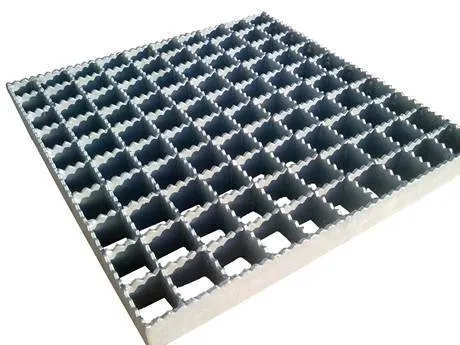
In-house weld & press lines
Electro-forging and press-locking under one roof
Certified & tested
Reports on request, MTC with every order
Samples in 5–7 days
Production in 15–25 working days
FOB Tianjin
Shipped worldwide, EXW / CIF negotiable
Quick answer
The Short Answer
Choose steel grating in four steps: pick a type — welded for strength, press-locked for close mesh, swage-locked for fine patterns — set the span, match the load class, then choose a material such as Q235B, SS304 or SS316. Send your span and load to our engineers for an itemized quote within 24 hours.
Step one — type
What Types of Steel Grating Should I Choose?
The forming process decides load behavior, mesh density and flatness. Three processes cover almost every project, and all three run on our in-house lines.
Welded steel grating
Every bearing-bar and cross-bar joint resistance-forged into one panel. The default for platforms, walkways and trench covers where loads are high.
Press-locked grating
Cross bars mechanically pressed into notched bearing bars — no weld heat, so panels stay flat and can run down to 11/11 mm close mesh for tree pits and fine floors.
Swage-locked grating
Cross bars swaged through pre-punched bearing bars for high transverse stiffness and dense patterns — assessed per project on our press line.
Step two — span
How Do I Set the Right Span and Bar Size?
Span is the distance between supports, and it drives the bearing bar size. Our welded range runs from 20×3 mm up to 100×8 mm flat bar, plain or serrated, with bar spacing at 30, 40 or 60 mm centers and panels up to 1.25 m wide by 6 m long.
Rule of thumb: keep the supported span short and let the load pick the bar. For pedestrian traffic, 20×3 mm bars at 30/40 mm spacing is a common start; for forklift traffic, thicker bars and closer centers carry the day.
Send Your Span for a Spec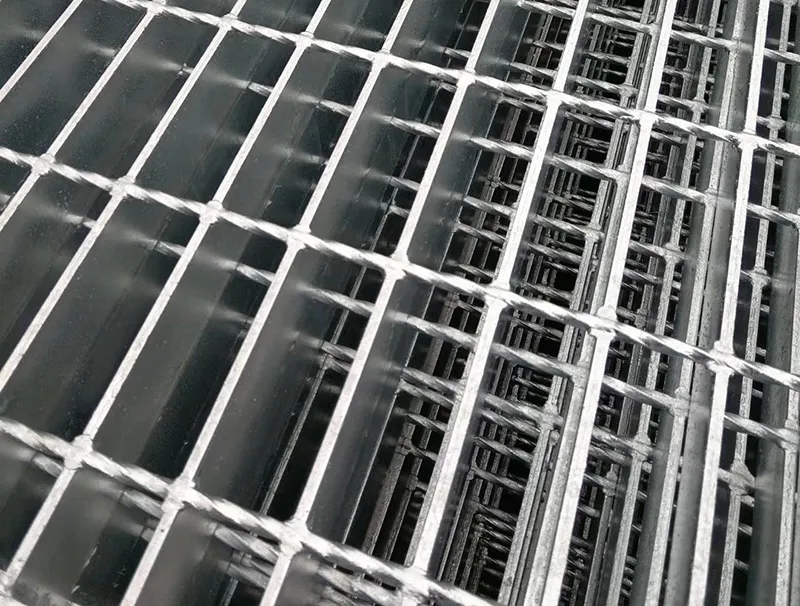
Step three — load
Which Load Class Does My Project Need?
Load class is really a conversation between your live load and the span. Tell us both and we match bar size and spacing, then issue load tables with the quote.
Standard duty
Pedestrian and light maintenance loads. Bars 20×3 mm upward, spacing 30 / 40 / 60 mm, produced to ANSI/NAAMM MBG 531 reference practice.
Heavy duty
Forklift and wheel traffic. Thicker bearing bars and closer centers, produced to MBG 532 practice for heavy service.
Per project
Live load and span given by the engineer. Load table and calculation sheet issued with your quote — no guessing.
Step four — stairs
How Do I Choose Steel Grating for Stairs?
Stair grating means treads, and treads add three extras over plain panels: cut corners to clear the stringer, banded edges to keep bars in place, and serrated or plain surfaces for grip. To know how to choose steel grating for stairs, size treads to your rise/run first, then pick the surface. Specify serrated for wet or oily environments and plain where cleanliness matters.
Give tread size and rise/run
Treads are made to stair dimensions — depth, width and the cut corner per your layout. Stair loading follows OSHA 29 CFR 1910.24(c) in US projects.
Pick surface and finish
Serrated teeth on the leading edge, plain or serrated surface, hot-dip galvanized or stainless. Nosing options are available.
Confirm with a drawing review
We review your stair layout for free and confirm quantity, banding and end plates before the 24-hour quote.
| Tread feature | Why it matters |
|---|---|
| Serrated surface | Bites into wet or oily soles; best for outdoor and industrial stairs |
| Plain surface | Easier to keep clean; good for food and washdown areas |
| Cut corners | Fit around the stair stringer without on-site cutting |
| Banded edges | Keep bearing bars from moving; cleaner finished edge |
| Nosing | Visible leading edge on the tread for step definition |
Comparison table
Steel Grating Types at a Glance
One table to compare the forming processes — the fastest way to shortlist before you send drawings.
| Dimension | Welded | Press-Locked | Swage-Locked |
|---|---|---|---|
| Forming principle | Every intersection resistance-forged under pressure | Cross bars mechanically pressed into notched bearing bars | Cross bars swaged through pre-punched bearing bars |
| Load behavior | High capacity at wide spans; joints cannot work loose | Very uniform distribution; suited to pedestrian traffic | High transverse stiffness; holds fine bars firmly |
| Mesh range | 30 / 40 / 60 mm centers | Down to 11 / 11 mm close mesh | Dense patterns; depends on bar selection |
| Panel flatness | Flat panels straight off the line | Extremely flat — no weld heat, no distortion | Flat; depends on bar tolerances |
| Typical use | Platforms, walkways, trench covers, guardrails | Municipal trench, tree pits, facades, fine floors | Architectural and fine-mesh flooring |
| Our lines | In-house electro-forging line | In-house press-lock machine | Assessed per project on our press line |
Not sure which fits your loads? Send your drawings — we will spec it inside the 24-hour quote.
FAQ
Frequently Asked Questions
Do you help with steel grating selection?
Yes — free drawing review is part of every quote. Send your span, live load and environment and our engineers reply within 24 hours with an itemized spec: type, bar size, spacing, material and finish.
Can I get load tables and material certificates with my order?
Load tables are issued with your quote, and every order ships with an MTC to EN 10204 Type 3.1, a factory inspection report and a Declaration of Conformity per ISO 17050. Third-party testing on request.
What are your sample and production timelines?
Samples ship in 5–7 working days and mass production runs 15–25 working days after drawing confirmation, both including hot-dip galvanizing. Quote within 24 hours.
Free spec sheets
Get the Spec Guide
Read the guide, then order from the factory direct. Send your span, load and material — we reply within 24 hours with spec sheets matched to your project and an itemized quote.
- Spec sheets and load tables matched to your project
- DoC, MTC EN 10204 3.1 and inspection report with every order
- Small trial orders welcome — samples in 5–7 days
Prefer to talk? WhatsApp us or sales@dtsteelladder.com
Request your spec sheet
Five fields — we do the rest.
Related pages
Related Guides & Product Pages
What Is Bar Grating
The plain-language definition of bar grating to start from.
View page →Steel Grating Material
Q235B vs SS304 vs SS316 — when to pick which.
View page →Stainless Steel Grating Specification
SS304 / SS316 spec guide with bar sizes and spans.
View page →Types of Steel Grating
Every grating type compared in one place.
View page →Grating Installation
Panels, fixings and layout in practice.
View page →Welded Steel Grating
The workhorse panel behind most structural specs.
View page →