Factory-direct steel gratings & stair treads, shipped worldwide
Grating in Steel Structure
Welded vs press-locked: spans, loads and close-mesh answers, compared.
Itemized quote within 24 hours · Free drawing review included
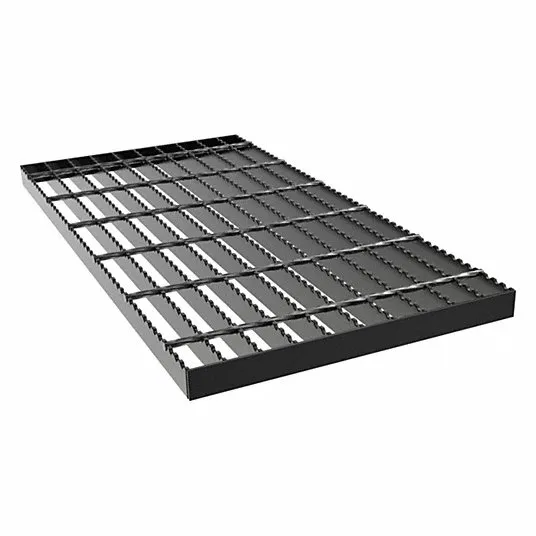
In-house weld & press lines
Electro-forging and press-locking under one roof
Certified & tested
Reports on request, MTC with every order
Samples in 5–7 days
Production in 15–25 working days
FOB Tianjin
Shipped worldwide, EXW / CIF negotiable
Quick answer
The Short Answer
Steel grating in a structure sits on the main beams and spans across them, with the bearing bars running at right angles to the supports. Welded grating carries heavier loads over longer spans, while press-locked grating offers close mesh and a smoother finish. The clear span between supports decides bar size, spacing and load rating.
Span direction
Which Way Does Grating Span in a Steel Structure?
Grating always spans across the supports. The bearing bars are the long flat bars that carry the load, and they run at right angles to the supporting steel — never along it. The span is the clear distance between those supports, and the load table is built on that number.
Bearing bars carry the load
The long flat bars are the load-carrying members. They cross the supports, so their direction and pitch are what the engineer sizes.
Span is the clear distance
The unsupported gap between two supports sets the bar size, spacing and load rating. Not the panel width — the clear span across the beams.
Load tables follow the span
Tell us the clear span and the live load, and we match the bearing bar and issue a load table with your quote.
Process comparison
Press-Locked Grating vs Welded — Which Should You Use?
Welded grating is the structural workhorse: cross bars are resistance-welded to every bearing bar, forming one solid panel that handles heavy loads over long spans. Press-locked grating is built without welds — cross bars are locked into slots under pressure, giving a smooth finish and very close mesh. Both run on our in-house lines.
Choose welded for span and load
Resistance-welded joints give a solid panel that carries heavy loads over long clear spans — the standard choice for platforms, walkways and heavy-duty floors.
Choose press-locked for close mesh and finish
Pressure-locked bars give a smooth, flush surface with no weld heat, reaching close mesh for fine and decorative panels, tree pits and facades.
Close mesh
When Does Close-Mesh Grating Matter?
Close mesh matters where objects or heels could slip through an open bar pitch — mezzanine edges, stair landings, tree pits and facade screens. Press-locked panels reach the tightest spacing, down to around 11 / 11 mm. Welded panels cover the standard 30 / 40 / 60 mm pitches that suit most walkways and platforms.
Ask Which Mesh Your Project NeedsComparison table
Welded vs Press-Locked: Side by Side
One table to compare the two processes inside a steel structure — the fastest way to shortlist before you send drawings.
| Factor | Welded grating | Press-locked grating |
|---|---|---|
| Clear span | Best for longer spans and heavy duty | Best for short spans and fine mesh |
| Load capacity | High — every joint resistance-welded | Light to medium — pedestrian duty |
| Close mesh | Standard 30 / 40 / 60 mm pitches | Down to about 11 / 11 mm close mesh |
| Surface finish | Slight weld marks at joints | Smooth, flush top face |
| Typical use | Platforms, walkways, heavy floors | Facades, tree pits, fine platforms |
| Our position | Produced on our in-house electro-forging line | Produced on our in-house press-locking line |
Not sure which way your panels should span? Send your drawings — we will spec it inside the 24-hour quote.
One factory, both processes
Welded and Press-Locked, Quoted Side by Side
We produce welded and press-locked grating on in-house lines, so both options come from the same factory — panels, treads and covers in one order. Load tables and MTC EN 10204 Type 3.1 documents are issued with your quote, and small trial orders are welcome.
Get the Spec Guide
FAQ
Frequently Asked Questions
Which way does grating span in a steel structure?
Grating spans across the supports, so the bearing bars run at right angles to the supporting steel. The clear span between supports sets the bar size, spacing and load rating. Tell us the span and the live load, and we match the bearing bar to it and issue a load table with your quote.
Which should I choose — press-locked grating or welded grating?
Welded grating suits longer spans and heavier loads because the cross bars are resistance-welded to every bearing bar. Press-locked grating suits fine-mesh, smooth-finish and decorative work where close spacing matters more than ultimate strength. We produce both on in-house lines and can quote them side by side.
What are your sample and production timelines?
Samples ship in 5–7 working days and mass production runs 15–25 working days after drawing confirmation, both including hot-dip galvanizing. Quote within 24 hours.
Free spec sheets
Get the Spec Guide
Read the guide, then order from the factory direct. Send your span, load and material — we reply within 24 hours with spec sheets matched to your project and an itemized quote.
- Spec sheets and load tables matched to your project
- DoC, MTC EN 10204 3.1 and inspection report with every order
- Small trial orders welcome — samples in 5–7 days
Prefer to talk? WhatsApp us or sales@dtsteelladder.com
Request your spec sheet
Five fields — we do the rest.
Related pages
Related Guides & Product Pages
How to Choose Steel Grating
Pick type, span, load class and material in four steps.
View page →Welded Steel Grating
The workhorse panel behind most structural specs.
View page →Press-Locked Grating
Close mesh and smooth finish for fine and decorative work.
View page →Close-Mesh Grating
Tight spacing for tree pits, landings and heel-proof areas.
View page →Types of Steel Grating
Every grating type compared in one place.
View page →Technical Resources
Load tables, span guides and calculators in one place.
View page →